In this guide
The short answer
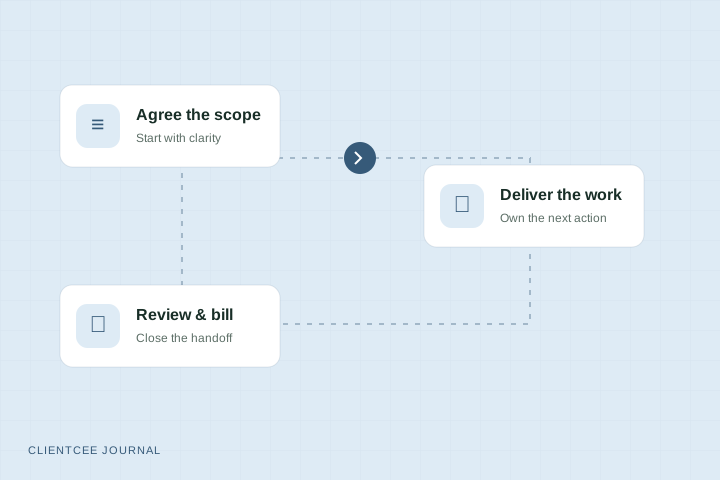
Write an agency project brief by agreeing the purpose, audience, deliverables, boundaries, responsibilities, dependencies, and review conditions. Record the current version and decision-makers, resolve kickoff questions, and give the delivery team a clear reference for the work.
What an agency project brief needs to do
A project brief should make the engagement understandable to someone who did not attend the sales conversation. It records the purpose, deliverables, boundaries, responsibilities, dependencies, and review conditions the team is agreeing to work from.
The brief is useful when it changes a decision. A designer can see who the work is for. A project owner can identify a missing input. A client knows which decisions they need to make. A long document that leaves those questions unanswered still needs work.
Use the free agency project brief template as an editable starting point. Complete it with the client and delivery lead rather than treating it as a questionnaire to file away.
Start with the outcome and the audience
Ask what needs to change for the client and who the work is intended to help. Separate the requested output from its purpose. “Redesign five service pages” describes an output. “Help prospective clients understand the services and reach the right enquiry path” explains a purpose the team can use when assessing decisions.
Then identify how you will review the agreed work. Choose criteria the team can actually assess. Delivering a website does not establish that a future sales target will be met, especially when factors outside the engagement influence that result.
Record unresolved questions explicitly, with someone responsible for answering them. An unknown budget, content owner, or access dependency is more useful as a visible question than as an assumption everybody interprets differently.
Define the deliverables and their boundaries
List the outputs with enough detail to recognize a change. Quantities, formats, intended uses, and responsibilities often matter more than a broad service label.
The following website example is illustrative, not a ClientCee customer case study.
| Brief item | A decision the team can work from |
|---|---|
| Deliverables | Five named page designs and responsive implementation using supplied brand assets |
| Content | Client supplies approved copy; agency places the agreed content |
| Review | One named client decision-maker consolidates feedback on the current deliverable |
| Dependency | Final copy is needed before the relevant design review |
| Scope question | A later request for a sixth page needs an impact assessment and decision |
Keep exclusions factual and relevant. Their purpose is to help both sides understand the boundary, not to produce a defensive list. If a responsibility is important to delivery, record who owns it and when it is needed.
Agree who can make each decision
An account contact, a person providing feedback, and a person authorized to approve a commercial change may have different roles. Clarify those roles before they become a bottleneck.
For a small engagement, one person may hold several responsibilities. Record the responsibility anyway. A colleague should be able to take over a handoff without guessing who to ask.
Agree how feedback becomes a decision. Useful feedback identifies the current item, the criterion being assessed, and the response needed. When several client stakeholders participate, decide how their comments will be consolidated before the next production round.
Turn dependencies into a readiness check
People are a dependency too. Use the agency team capacity calculator to compare proposed hours with each role’s available billable capacity and existing commitments. Spare hours in one role may not resolve another role’s shortage.
Content, access, supplied assets, and client decisions can determine when work is ready to start. List each important input with its owner and the point at which it is needed.
Avoid asking the client to put passwords or other secrets into a general brief. Use an appropriate access-sharing process and record that access is ready, rather than reproducing credentials in a widely shared document.
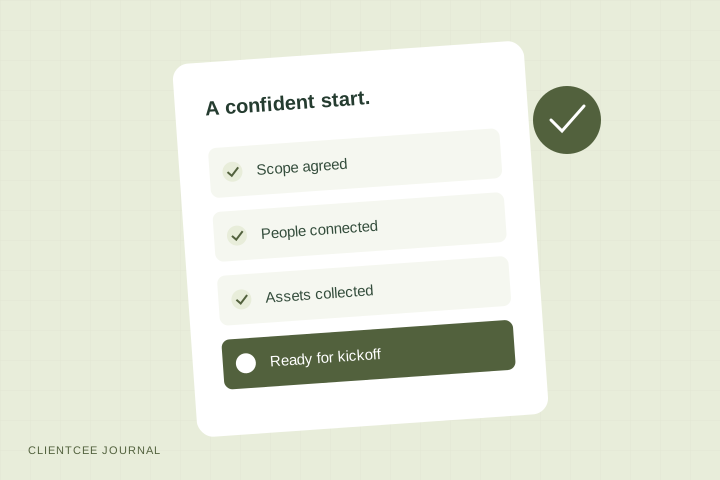
A practical kickoff check asks:
- Are the purpose, deliverables, and boundaries agreed?
- Can the assigned people find the current brief?
- Are the first milestone's required inputs available?
- Does the client know what the first review will ask them to decide?
- Is there an owner for each remaining question?
The client onboarding checklist covers the wider handoff from an agreed engagement into delivery.
Connect the brief to the project and the agreement
Record the version, date, and people who agreed the brief. Keep a clear reference to the relevant estimate or agreement. Where the brief and agreement differ, resolve the difference through your agency's agreed process before relying on either to authorize work.
In ClientCee, the relevant project and task records can organize delivery responsibilities, while estimates, contracts, and invoices serve their own commercial purposes. Decide how your team will reference the current brief and confirm the access available to employees and clients. The template is an editable document, not an automatic import or a replacement for the agreement.
For a website engagement, the web design agency workflow shows how those responsibilities connect from discovery to handover.
Keep the brief current through explicit changes
A brief should not silently absorb every new request. When a request affects the agreed deliverables, effort, timing, or responsibilities, compare it with the current version and obtain the relevant decision.
Preserve the original context and identify the revision that becomes current. Update the affected work after the decision, then tell the people who need to act on it. The scope-change guide explains that process.
Common questions
Who should write the brief?
The agency owner or account lead can coordinate it, but the delivery lead and client decision-maker should resolve the parts they are responsible for. The person formatting the document does not need to make every decision alone.
How long should a project brief be?
Long enough to make the engagement, boundaries, responsibilities, and next actions clear. Use the complexity of the work to decide the detail; there is no useful universal page count.
Is a brief the same as a proposal or contract?
They serve different purposes. A proposal explains the intended offer, an agreement records the commercial arrangement, and a brief helps the team understand the work. Keep them consistent and use the agreement's process for material changes.
What should we do when an answer is unknown?
Record the question, its owner, and the decision date needed. Decide whether the missing answer blocks the next milestone rather than inventing an answer to make the document look finished.
Published by ClientCee. See how these guides are prepared.